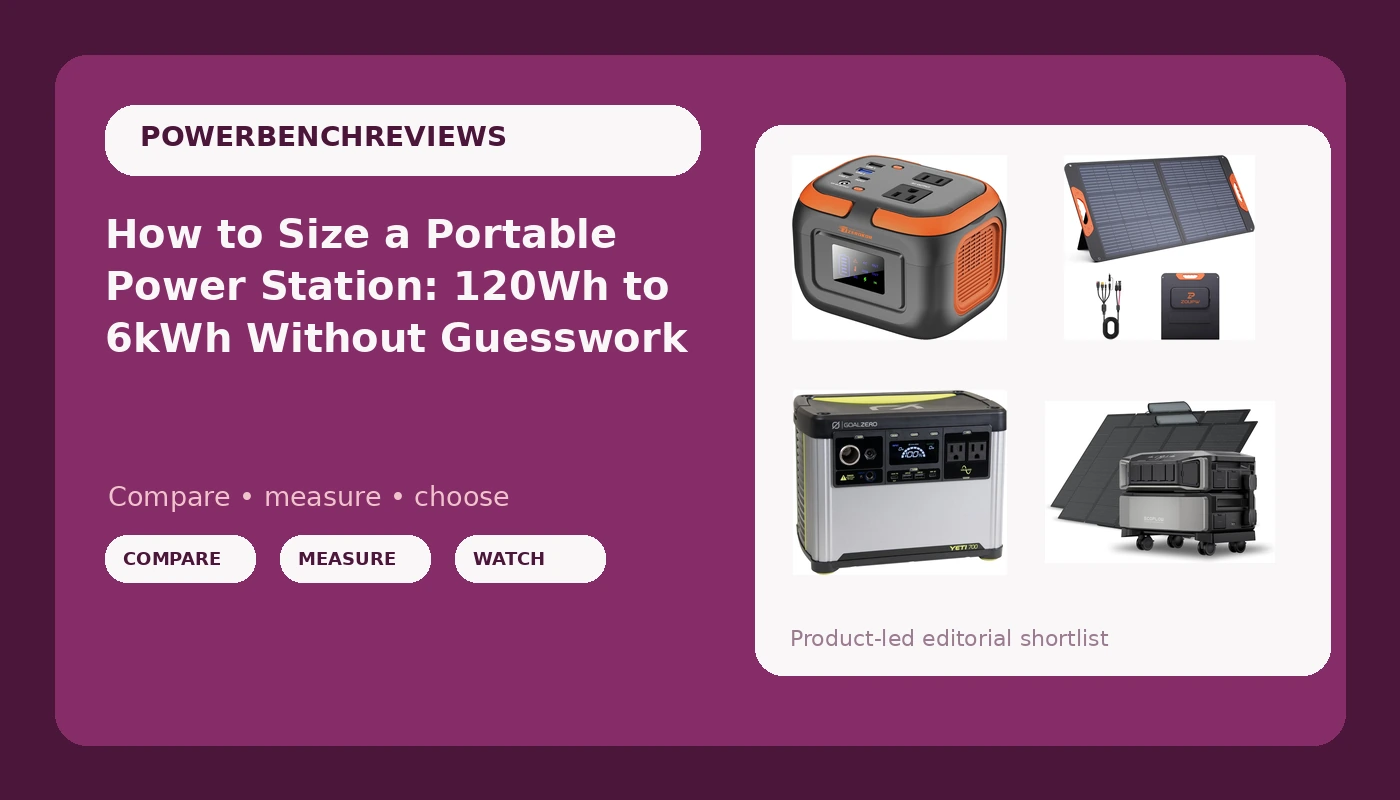
Most people shopping for backup power start with the wrong question. They ask which unit is the strongest, then discover that sizing a portable power station is really arithmetic: what you plug in, how long it has to run, and how you put the energy back afterward. A 120W unit that keeps a phone, a router, and a laptop alive through an evening outage and a 6,144Wh system that carries a house through a multi-day grid failure are not competing products. They solve different problems. The spec sheet will not tell you which problem is yours, but a load list will.
Related: How to Calculate Power Station Runtime Without Guessing →
Quick answer
Size to the load, not to the biggest number you can afford. If your critical load is phones, laptops, lights, and a router, a 120W class station covers it. If you need a fridge, a CPAP machine, or a full weekend of camping, the 677Wh LiFePO4 tier is the realistic middle. If you are backing up a house through a multi-day outage, whole-home backup starts at the 6,144Wh class. A folding 100W solar panel is an accessory decision, not the main one, and it should be chosen after the battery, never before it.
Four useful options
| Model | Best fit | What stands out |
|---|---|---|
| Portable Power Station 120W, 110V Power Bank with DC AC Outlet | Phones, laptops, lights, small fans | 120W class output with both AC and DC outlets |
| Goal Zero Yeti Portable Power Station, Yeti 700, 677 Watt Hour LiFePO4 Battery, Water Resistant & Dustproof Solar Generator for Outdoors, Camping, Tailgating, & Home, Clean Renewable Off-Grid Power | Camping, tailgating, fridge and CPAP backup | LiFePO4 chemistry in a water resistant, dustproof housing |
| ZOUPW 100W Portable Solar Panel for Power Station,23.5% Efficiency Mono Foldable Solar Charger for Jackery 300/Ecoflow River/Anker/Bluetti,IP67 Waterproof for Camping RV Off-Grid Emergency Power | Recharging a mid-size station away from an outlet | 23.5% efficiency mono cells in a foldable, IP67 rated frame |
| EF ECOFLOW Power Station 6144Wh DELTA Pro Ultra with 2x400W Portable Panel | Whole-home backup and long outages | 6,144Wh of storage bundled with two 400W portable panels |
The entry point: Portable Power Station 120W, 110V Power Bank with DC AC Outlet
The 120W figure is a ceiling on instantaneous draw, not a measure of stored energy, and that distinction trips up a lot of first-time buyers. A 120W ceiling rules out space heaters, microwaves, coffee makers, and full-size refrigerators no matter how long you are willing to wait. What it does well is keep a phone, a tablet, a router, and a couple of LED lights running through an evening outage, which is the actual emergency most households face. If your list ends there, buying more battery is buying weight you will never use. If your list includes anything with a heating element or a compressor, move up a tier.
The middle tier: Goal Zero Yeti Portable Power Station, Yeti 700, 677 Watt Hour LiFePO4 Battery, Water Resistant & Dustproof Solar Generator for Outdoors, Camping, Tailgating, & Home, Clean Renewable Off-Grid Power
This is the tier where chemistry starts to matter more than capacity. LiFePO4 cells generally tolerate more charge cycles and handle being held at a partial state of charge better than the older lithium chemistries, which is why I treat LiFePO4 as the baseline for anything meant to sit in a closet for two years and then work. The 677Wh figure puts you in range for a small fridge on a duty cycle, a CPAP machine overnight, or a weekend of van camping with lights, a fan, and device charging. It is also a size one person can still carry, which stops being true very quickly above this class. The water resistant and dustproof housing matters more than it sounds if the unit lives in a truck bed or a tent.
The solar add-on: ZOUPW 100W Portable Solar Panel for Power Station,23.5% Efficiency Mono Foldable Solar Charger for Jackery 300/Ecoflow River/Anker/Bluetti,IP67 Waterproof for Camping RV Off-Grid Emergency Power
Panels are the weakest link in almost every bundle, and the reason is physics rather than branding. A panel's rated watts are measured under standard test conditions: full sun, a specific cell temperature, and a specific angle. Real campsites deliver clouds, shade from a pine, a low winter sun, and panels laid flat on the ground because that was the easy spot. Expect a meaningful gap between the label and what actually reaches the battery, and plan your recharge time around that gap. The compatibility list on this panel covers several popular station families, but check your station's solar input connector and voltage window before you assume a match. A 100W panel is a sensible companion for a mid-size station and a slow trickle for a whole-home unit.
The whole-home class: EF ECOFLOW Power Station 6144Wh DELTA Pro Ultra with 2x400W Portable Panel
At this capacity the product stops being portable in the everyday sense and becomes a small installed power system. That changes the questions you ask. Instead of weight and handle comfort, you are asking where it lives, how it gets recharged during a week of smoke or cloud cover, and whether your critical circuits can be fed from it at all. The two 400W panels in this listing make a genuine solar recharge path possible, but they will not refill 6,144Wh in an afternoon, so most owners pair a system this size with a wall or generator recharge plan and treat solar as the extender. Buyers in wildfire country should think of this tier as insurance with a long service life rather than a camping accessory.
Prices and availability may change. Product images, names, and retailer links are matched to verified listings. No current price, rating, stock status, or measured result is stated here without current evidence.
Watt-hours, watts, and the number that actually matters
Watt-hours measure stored energy. Watts measure how fast you pull it out. Those are different units, and confusing them is the single most common mistake in this category. If a device draws 50W and you run it for four hours, you used 200Wh. A 677Wh station can cover that load roughly three times over, minus conversion losses. The same 677Wh station asked to run a 700W appliance will not last an hour, because the draw is far higher. Divide watt-hours by running watts to get a rough runtime, then knock off a chunk for inverter losses and battery behavior.
Three details change the answer more than the headline capacity does. First, inverter efficiency: converting DC battery power to 110V AC is not free, and every conversion costs you some of the stored energy as heat. Second, chemistry: LiFePO4 packs generally give you more usable cycles and better long-term behavior than older lithium cells. Third, surge versus sustained draw: motors in fridges and pumps pull a brief spike on startup that can be several times their running watts, so a station rated just above the running load may still trip on startup. None of these numbers appear in the marketing headline, and all of them decide whether the unit works when you need it.
How to size a station in five steps
- Write down every device you want to run, with its running watts printed on the label or power supply.
- Estimate how many hours per day each device actually runs, not how long it is plugged in.
- Multiply watts by hours for each item, add the results, then add roughly 15 percent for inverter and conversion losses.
- Separate the list into essential loads and comfort loads, and size the battery to the essentials first.
- Decide how you will recharge: wall outlet, vehicle 12V, or solar, and confirm the station's input ratings match that plan.
Practical guidance
- Buy for the outage you have actually experienced, not the one in a disaster film.
- Treat solar as a recharge method with weather risk, and keep a wall or vehicle option in reserve.
- Check outlet types before buying: 110V AC, DC, and USB outputs are not interchangeable across devices.
- Store the unit where temperatures stay reasonable, and top it up on a schedule rather than once a year.
- Run a real test with your actual devices before storm season, so you learn the limits on a calm afternoon.
Which option should you choose?
Choose the Portable Power Station 120W, 110V Power Bank with DC AC Outlet when your critical load is phones, laptops, a router, and lights, and you want something small enough to keep in a go bag. Choose the Goal Zero Yeti Portable Power Station, Yeti 700, 677 Watt Hour LiFePO4 Battery, Water Resistant & Dustproof Solar Generator for Outdoors, Camping, Tailgating, & Home, Clean Renewable Off-Grid Power when you need to run a fridge, a CPAP, or a full camping weekend and you want LiFePO4 chemistry in a housing built for outdoor conditions. Choose the ZOUPW 100W Portable Solar Panel for Power Station,23.5% Efficiency Mono Foldable Solar Charger for Jackery 300/Ecoflow River/Anker/Bluetti,IP67 Waterproof for Camping RV Off-Grid Emergency Power when you already own a compatible mid-size station and want to recharge it away from an outlet. Choose the EF ECOFLOW Power Station 6144Wh DELTA Pro Ultra with 2x400W Portable Panel when the goal is keeping a house running through a long outage and the budget reflects a permanent piece of equipment.
A caveat worth stating plainly: this comparison is built from listing specifications, not from a bench session on these specific units. Sustained-load behavior, fan noise under load, app reliability, and true usable capacity are the things that separate a good station from a disappointing one, and those show up only in testing. If a purchase hinges on one of those factors, look for independent load testing before you commit.
The bottom line
Sizing a portable power station is a math problem before it is a shopping problem. Add up your loads in watt-hours, add margin for conversion losses, and let that number pick the tier for you. The 120W class handles the small electronics outage, the 677Wh LiFePO4 tier handles camping and appliance backup, a 100W folding panel extends a mid-size station off-grid, and the 6,144Wh class is where whole-home backup begins. Pick the tier that matches your real list, then spend the difference on more battery rather than more panels.