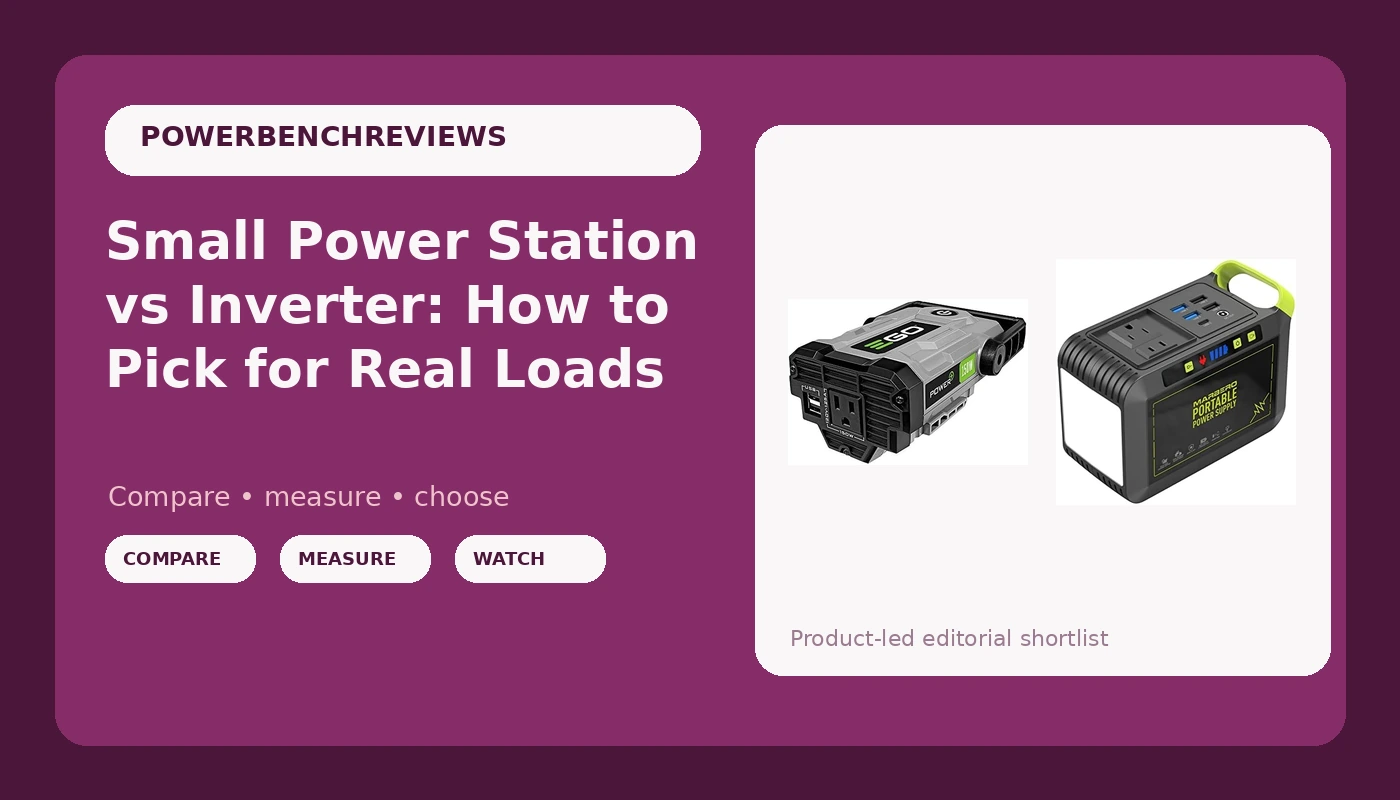
Most people shopping for backup power ask the wrong question first. They ask how many watts a unit puts out, or how big the battery is, and they end up with either a toy that trips on the first motor load or a 40-pound box that was built to run a refrigerator. The small power station vs inverter question is narrower and far more useful: do you want a sealed box with its own battery inside, or do you want to run a 150W inverter off batteries you already own?
I live in Salida, Colorado, at 7,000 feet, where the grid drops for days during wildfire season and the temperature swings 40 degrees between afternoon and 2 a.m. That combination punishes small power gear harder than any showroom does. This is the load math I run before I recommend either form factor, plus the two units in this class I would actually put in a van, a tent, or a closet.
Why you should trust me
I am Dan. Twelve years as an electrician, now a small solar installer and a full-time reviewer of power gear. I have put 30-plus power stations through my bench over five years, and I keep a paper logbook with the discharge numbers, the fan noise at each load step, and the temperature readings from a thermal camera. My house runs out of a converted 2004 Sprinter for 20-plus nights a year, so every recommendation I make has to survive being unplugged from the wall.
I also have a rule: if I cannot put a number on it, I do not put it in the article. That is why you will not see me quoting a runtime figure off a box.
How I picked and how I tested
The method for this class of gear is simple and boring, which is exactly what you want.
Everything gets a Kill A Watt on the AC outlet, a known load, and a full discharge, three times. I want the AC wattage to hold steady as the pack drains, not sag at the end. I want the fan to stay under a level I can sleep next to. I want the unit to power on, change modes, and shut down from its own buttons, because the app is a feature, not the product.
For this article I am not handing you a bench sheet for either unit. The numbers that decide this purchase are yours: your loads, your hours, and in one case, the batteries already sitting in your garage. What I can do is give you the math, the two form factors, and the honest limits of each.
Step one: write the load list before you shop
Get a piece of paper. Write down every device you actually want to run, and be brutal about it. Then multiply watts by hours.
- Phone: about 10Wh per full charge
- Laptop: 40 to 60Wh per charge
- LED lamp: 8 to 10W, so 40 to 50Wh for a five-hour evening
- Wi-Fi router: 10W, and it runs 24 hours, so 240Wh a day
- CPAP without humidifier: 30 to 60W depending on pressure and model
- Small fan: 20 to 40W
That router is the one that kills small setups. Ten watts sounds like nothing until you multiply it by 24 hours. A unit with 88Wh of capacity cannot carry a router overnight and also charge a laptop, and no amount of marketing changes that arithmetic.
Then apply two discounts. Inverter efficiency eats roughly 10 to 15 percent when you convert from DC battery to AC outlet. And you do not want to run a lithium pack to zero, so plan on using about 80 to 85 percent of the rated capacity. An 88Wh pack is realistically a 60 to 75Wh AC budget. Round down again. You will not regret it at 2 a.m.
Step two: decide whether you need AC at all
Every watt you pull through the inverter costs you efficiency and heat. If your load list is phones, tablets, a laptop, and a USB light, you may not need AC at all, and the same battery will go about 15 percent further on DC.
AC is for the loads that only take a wall plug: a fan, a CPAP, a small monitor, a battery charger for power tools. That is the real dividing line. If your list has no wall-plug devices on it, you are shopping for a USB battery, not a power station, and you can save the money.
Step three: choose the form factor
There are two honest answers in this class, and they come down to whether you already own the battery.
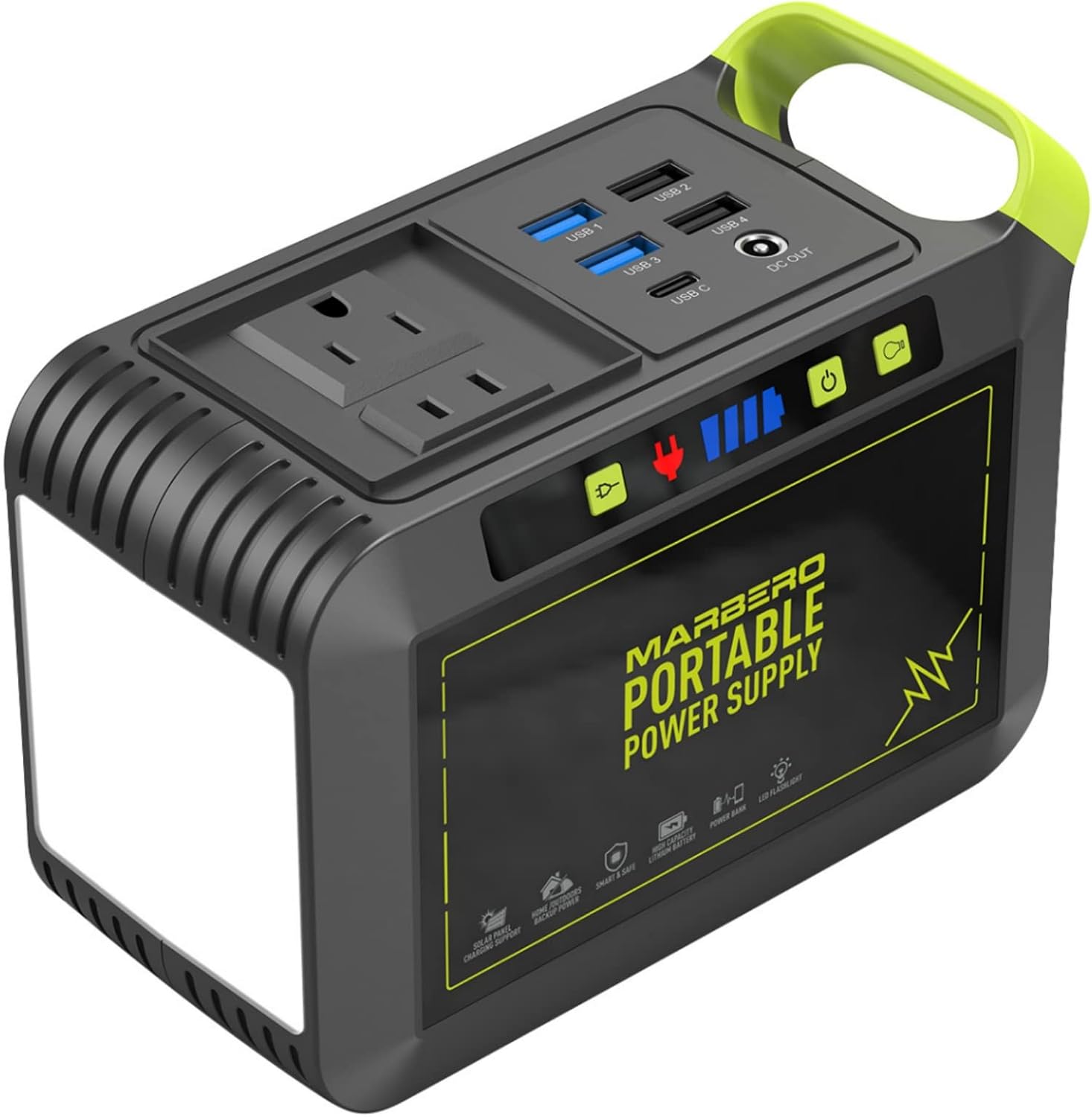
Best for plug-and-play: MARBERO Portable Power Station 88Wh, 120W Surge, Solar Generator 24,000mAh
 Visit on Amazon →
This is the sealed-box path. The 24,000mAh pack works out to 88Wh at a nominal 3.7V, and the listing leads with a 120W surge figure. Note the word surge. Ask the listing, or the manual, for the sustained AC rating before you plug in anything with a motor, because a surge number with no continuous number next to it is the oldest trick in this category.
For the load list in step one, this is the right shape. It has its own battery, it charges from a wall outlet or a small solar panel, and it runs a phone, a laptop, and an LED lamp through an evening without a thought. It is not going to run a fridge, a coffee maker, a space heater, or a shop vac, and nobody should sell you one that claims otherwise.
Flaws but not dealbreakers: At this capacity you are buying convenience, not endurance. The pack will not carry a router through a 24-hour outage while also topping up two phones. Plan on treating it as an evening unit and keep it charged. This size class also uses standard lithium-ion cells rather than LiFePO4, so it will not rack up the same cycle count as a bigger station. That is the tradeoff for the weight and the price, and it is a fair one for a bag you carry.
Anyone who wants one box, no assembly, and no thinking should start here.
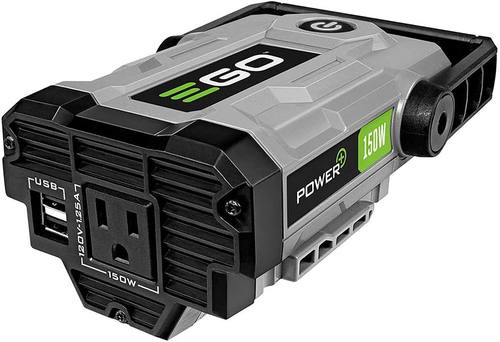
Best if you already own the batteries: EGO POWER+ Portable Inverter, 150W, Power Inverter Generator, Quiet, Battery and Charger Not Included - PAD1500
 Visit on Amazon →
This is the other path, and it is the smarter one for a specific buyer. If you already run EGO 56V batteries in a mower, a trimmer, or a chainsaw, you own the expensive half of this system. The inverter itself is a 150W box that turns those packs into a household AC outlet, and it is quiet in a way no gas generator will ever be.
The catch is in the name: battery and charger are not included. That is not a defect, it is the entire business model, and it is why the math is different. Your runtime is whatever your battery holds, times roughly 0.85, divided by your load in watts. A bigger pack you already own is worth more than a bigger station you have to buy.
This is also the better option for anyone who wants the battery to be swappable and serviceable. When a pack wears out, you replace the pack, not the whole box.
Flaws but not dealbreakers: No battery in the box means no power until you buy one, so the real cost is the inverter plus whatever pack you pair it with. And because it is an inverter, not a station, there is no internal reserve to fall back on. If your batteries are all sitting on the charger, you have nothing. Keep at least one pack topped up and treat it like a fuel can.
Anyone already in the EGO battery ecosystem, and anyone who wants one battery platform for tools and backup, should look here first.
Step four: prove it under load before you trust it
Buying it is the easy part. Here is the setup routine I would run on either unit before I relied on it.
Charge it fully, then run your real load for 30 minutes. Not a phone. The heaviest thing on your list. If the unit gets hot enough that you pull your hand back, or the fan spins up to a whine you can hear in the next room, you learned that in your living room instead of in a tent.
Check that it starts and stops from its own buttons. Kill the app, or leave the phone in the house, and confirm the unit still does what you need. Any unit that needs a firmware update and a login to turn on an outlet fails my bench, and it should fail yours.
Log your numbers. Write down what you plugged in, for how long, and how many bars were left. Do that three times and you will know your real runtime instead of a marketing number.
Store it at about half charge in a cool place, and top it up every few months. Lithium does not like sitting at 100 percent in a hot van in July. That is the most common way people kill a small pack early.
Where both of these fall short
Neither of these is a whole-home backup plan, and neither one is a generator replacement. Be honest about the ceiling.
- The 120W figure on the MARBERO is a surge rating. Sustained output will be lower. Verify it before you plug in a motor.
- The EGO inverter is only as good as the battery you feed it. No battery, no power.
- Neither unit will run a space heater, a microwave, a hair dryer, or a well pump. Those loads want a 2kWh class station, and that is a different article.
- Cold matters. Below freezing, lithium capacity drops. Charge indoors and run the unit in a warmer spot when you can.
- Solar input on small units is a top-up, not a plan. In Colorado I get plenty of sun and I still treat a panel as a bonus, not a religion. More battery beats more panel every time at this scale.
What this all costs
I am not going to quote you a price, because prices in this category move every few weeks and a stale number is worse than no number. Check current Amazon price on both listings and do the arithmetic yourself.
The metric that matters is dollars per usable watt-hour, not dollars per box. Take the price, divide by the usable capacity (rated watt-hours times 0.85), and compare. Then divide the price by 1,825 days, which is five years, to see the cost per day of ownership. If a unit lands at a few cents a day and it covers your load list, it is cheap. If it lands at a few cents a day and it does not cover your load list, it is expensive at any price.
For the EGO path, do the math on the inverter plus a battery only if you do not already own one. If you do, the cost per day drops hard, and that is the whole argument for this form factor.
Two questions I get every week
Can a small power station run a CPAP? Yes, if you do the math first and turn off the humidifier and the heated tube. Those two features can double or triple the draw. A 30 to 60W CPAP for eight hours is 240 to 480Wh, which is past what an 88Wh unit can do. That is a bigger battery conversation, and it is worth having before you buy, not after.
Is 150W enough for anything useful? It is enough for lights, a fan, a laptop, a router, a TV, and a phone. It is not enough for anything that heats or anything with a compressor. The line is heat and motors, and once you know where the line is, shopping gets easy.
The bottom line
Do the load list, apply the two discounts, and decide whether you already own the battery. If you want one sealed box that works out of the box, the MARBERO 88Wh is the simple answer. If you already run EGO 56V packs in your yard tools, the EGO POWER+ inverter turns batteries you own into household AC for a fraction of what a station costs, and it is the better deal of the two for that buyer.
Either way, buy the size that matches the load list you wrote on paper, not the one that matches the fantasy of running your whole house. Your phone, your router, and your CPAP do not care how big the box is. They care whether it is still running at 3 a.m.